

The Tree School Chronicles
Letters to the past and the future
It's 1985, a year before I was born. In Belgrade, the winter has loosened its grip, though its memory lingers in the bones and in the rationing of coffee, electricity and fuel. For twenty-four consecutive, blistering winter days in December and January, the daily temperature never rose above 0 °C. It was one of the longest freezing streaks in the city's recorded history. Now the cold and the blackouts have subsided and in an office on 6 Lenin Street, warmed by little more than resolve, someone, or several someones, bend over a page, searching for words of solidarity that Yugoslav women might send to the Palestinian women due to gather in Tunis.
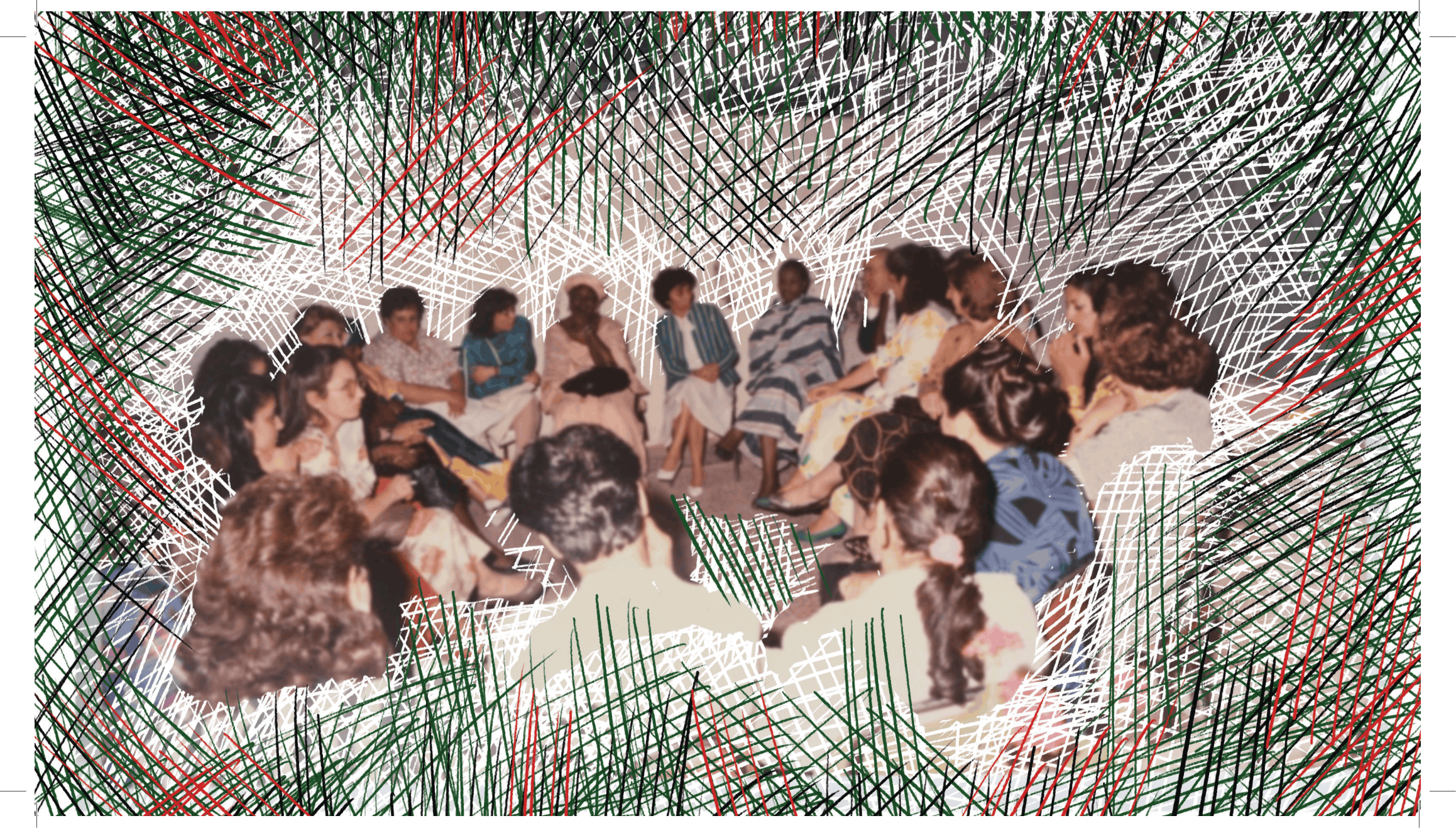
It's the same year, and spring lingers over Tunis as April turns to May. The air is mild and the light gentle. Inside the Hotel Amilcar, the Fourth Conference of the General Federation of Palestinian Women is in session. In attendance are “Palestinian sisters” who spent long years in the Zionist occupation's prisons, freed from captivity in late 1983. Some important men sit in the front row. A representative of the Federal Conference for the Issues of the Social Status of Women of Yugoslavia is about to deliver the greetings that travelled down the Adriatic and across the Mediterranean, a message carried by the same waters that touched different shores. She begins;
“Dear comrades,
I am very pleased to have the honour of conveying greetings to you on behalf of the Conference for the Issues of the Social Status of Women of Yugoslavia, and on behalf of all the women of Yugoslavia I thank you for the invitation you extended to the conference, and I hope that the work of your conference will be crowned with success.
[...]
The people of Yugoslavia and the women of Yugoslavia are aware of your just struggle for freedom and for the establishment of a free, independent Palestinian state, and of the difficulties you face in your popular liberation struggle. The contribution of women to your struggle is immense and an integral part of it. Without it, the goal, which is freedom, cannot be achieved.
The women of Yugoslavia, [...], led by the Communist Party of Yugoslavia, entered the field of struggle against fascism and Nazism and their collaborators during the Second World War. These days, and specifically on May 9th, Yugoslavia celebrates the victory over fascism, a victory achieved through the common struggle alongside other progressive peoples and nations, in which all the peoples and nationalities of Yugoslavia actively participated, including women on an equal footing. As we mark this anniversary, we highlight the great contribution women made to the people's liberation struggle and to the development of socialism. Since we ourselves have this experience, we sincerely affirm our support for your just struggle. We too lived through the siege of war and the fight for liberation, and at the same time, together with the other progressive forces in our society, our socio-political system declared the principles of a socialist society, in which men and women participate equally in all areas of decision-making. This is guaranteed by the constitution and laws of our socialist self-managing country.
[...]
We still encounter certain difficulties, and we must keep working for the consistent application of the constitution and the law, until the remnants of patriarchal consciousness and traditions are completely overcome, and until all the rights women gained through their contribution to the people's war, the revolution and the rebuilding of the country after the war are fully and lastingly realised. Women, the working class and all working people today take part in carrying out the tasks of completing the development of the political system of socialist self-management, accelerating material prosperity, completing the economic stabilisation program, strengthening brotherhood and unity among our nations and nationalities, and holding firm in international relations on the basis of the principles and aims of the policy of non-alignment, whose foundations were laid during President Tito's lifetime.
[...]
The Socialist Federal Republic of Yugoslavia [...] unequivocally support the struggle of the Palestinian people and insist on Israel's withdrawal, without conditions or restrictions, from all the Arab and Palestinian territories occupied in 1967, and for the realisation of the Palestinian people's inalienable rights to self-determination, independence and sovereignty, and to the establishment of their own state on their own land. [...]
[...]
Dear comrades, I wish once more that your conference's proceedings will be crowned with success, and that you will continue to improve the situation of Palestinian women. I also express our readiness to continue cooperation between the General Federation of Palestinian Women and the Conference for the Issues of the Social Status of Women of Yugoslavia.”
It's October 2026, and the weather in London has turned. The summer was apocalyptic. The heat that pressed down on the city for weeks left the parks faded to a dusty orange I have never seen here before. Now autumn seems to be arriving, and I am relieved by its crispness. My hands are cold.
I sit to read these messages from the past once more. The pages are cream-coloured and slightly skewed in their scans. I am using modern technology to decipher them, feeding the scans into a machine that reads the Arabic lines that I cannot. I am reminded that I really should have committed to learning the language. Maybe it's not too late. I should really do it soon.
I notice that page 3 of the speech appears to be missing. The numbers run 2, then 4, and I wonder whether it’s a typo, a slip of the numbering, or whether a whole page really is gone. Was it lost, misfiled, never scanned or kept? Did it even exist?
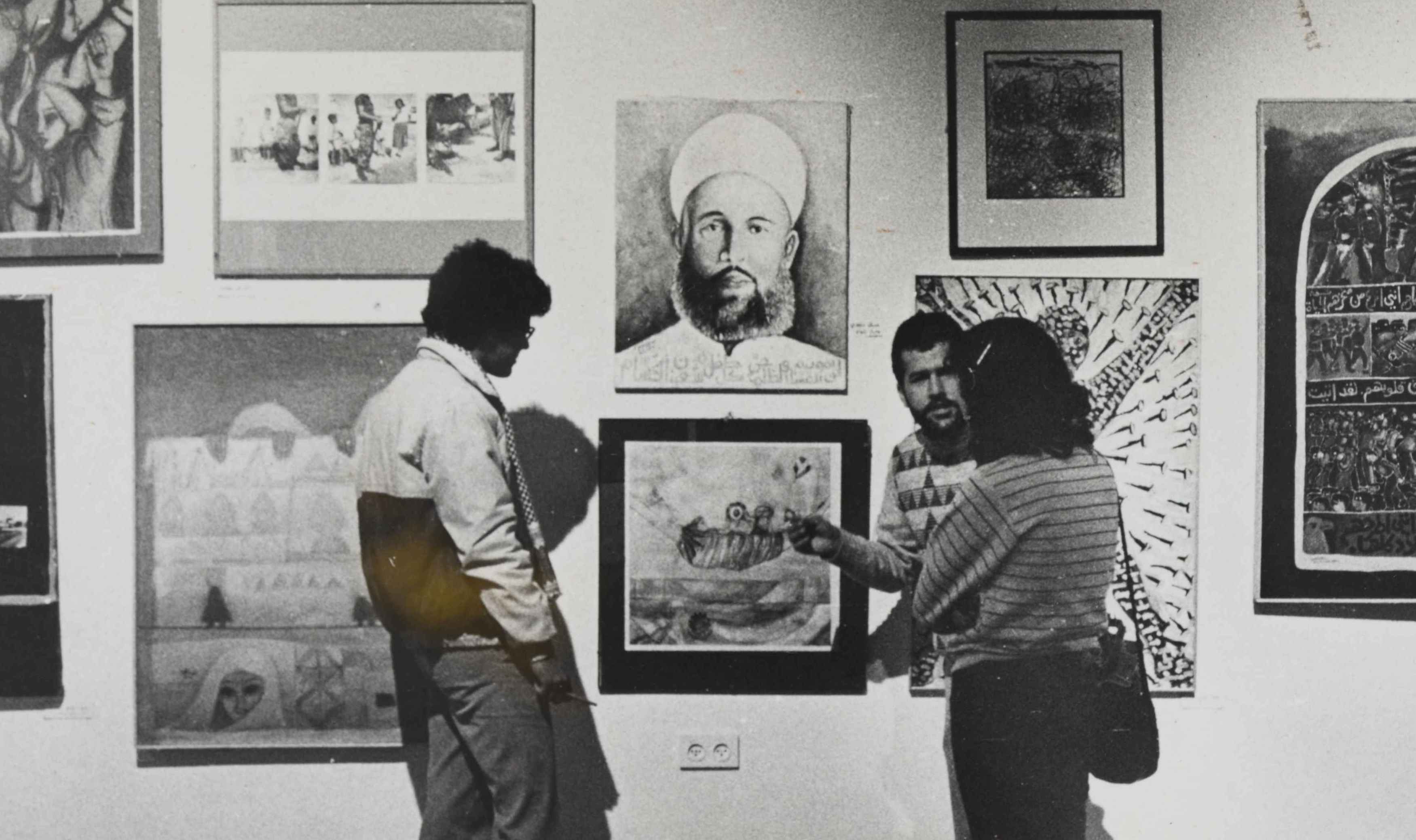
I think about the gaps in archives, and about my desire to fill them. I think about time travel and generational disappointments, and I wonder if the women in that hall thought of this too. I scan the photograph of the meeting held at the sidelines of the conference for signs of this. Impossible to know.
Just a few short months following the conference, on 1 October 1985, in an operation they called Wooden Leg, Israeli jets bombed the PLO's headquarters outside Tunis. In Belgrade, the brotherhood and unity named in the speech has a few years left, and the stabilisation programme will give way to inflation, then to war, and the country that sent the greeting will be gone before I am old enough to remember it.
In Celtic Christian tradition, a thin place is where two realms press so closely they almost touch. As I disappear deeper into the letters and speeches, I find myself in the orbit of familiar vocabulary. Time starts to feel like a thin place too. The distance between these pages and today feels more permeable than linear chronology allows. I am caught in the arc of a returning boomerang, suspended in constellations, not timelines.
Today, a free Palestine has yet to arrive. But we promise that it will. We insist that it will.
Prompted by Munira Khayyat, I think about what tense all this belongs in. I think about October. I think about ellipses. You sit in them too. Are the three dots comfortable?
I ask myself if time is a traitor and the archive a trickster. I drift into a daydream about the women at that conference, tasting freedom after years in the occupation's prisons. I think of the letters and poems I have written for almost two years to a friend who is held in one of those prisons today. Letters I cannot send. I think about his freedom as a debt that is owed to the sky.
Outside, the Sunday light is low. The sun slants in through my windows, bringing with it an unnerving sense of calm. I realise that I have already resolved to write in the present. I pour a second cup of coffee, and turn to another letter. I begin;
Dear A,
[...]
Angelina Radaković
London, UK


Introduction
The Tree School Chronicles is a day-by-day written response to the four Tree School sessions with Sandi Hilal and Alessandro Petti of DAAR from February 27 - March 2nd, 2023. It serves as an interpretive memory bank of the conversations, and a way to reverberate learnings across our wider community, particularly sharing a version of the discussion with those who may have missed a session but want to join the next one.
Every day for the week, an entry written by Reem Farah appeared chronicling the session that elapsed the previous evening.
Reem Farah is a researcher and writer at the intersection of art, politics, and society.
Day 1 | Creek Park
Sandi Hilal and Alessandro Petti’s work together through Decolonizing Architecture Art Research (DAAR) can be understood as a series of propositions about the humanity of spaces. The work of reinterpretation is evident in the oxymoronic formulations of their project titles such as ‘Commoning the Private’ (2021-), ‘Refugee Heritage’ (2015-2021), or ‘Concrete Tent’ (2015-16).
In 2012, Sandi and Alessandro began to explore spaces of knowledge creation in relation to the refugee camp through ‘Campus in Camps’ with the intention of highlighting refugee camps as a source of knowledge creation rather than as subject of humanitarianism and other forms of imposition.
In 2014, Sandi and Alessandro were invited to Bahia for the 31st Bienal de São Paulo. Coming from Palestine and preoccupied with the political notion of return, they posed the question of return to a collective of artist participants from the Quilombos community, descendants of a peoples brought to Brazil as slaves who continue to resist occupation today. Sandi recounts how in response to their prompt, the Quilombos representatives expressed: ‘We return each time we plant a Baobab tree’.
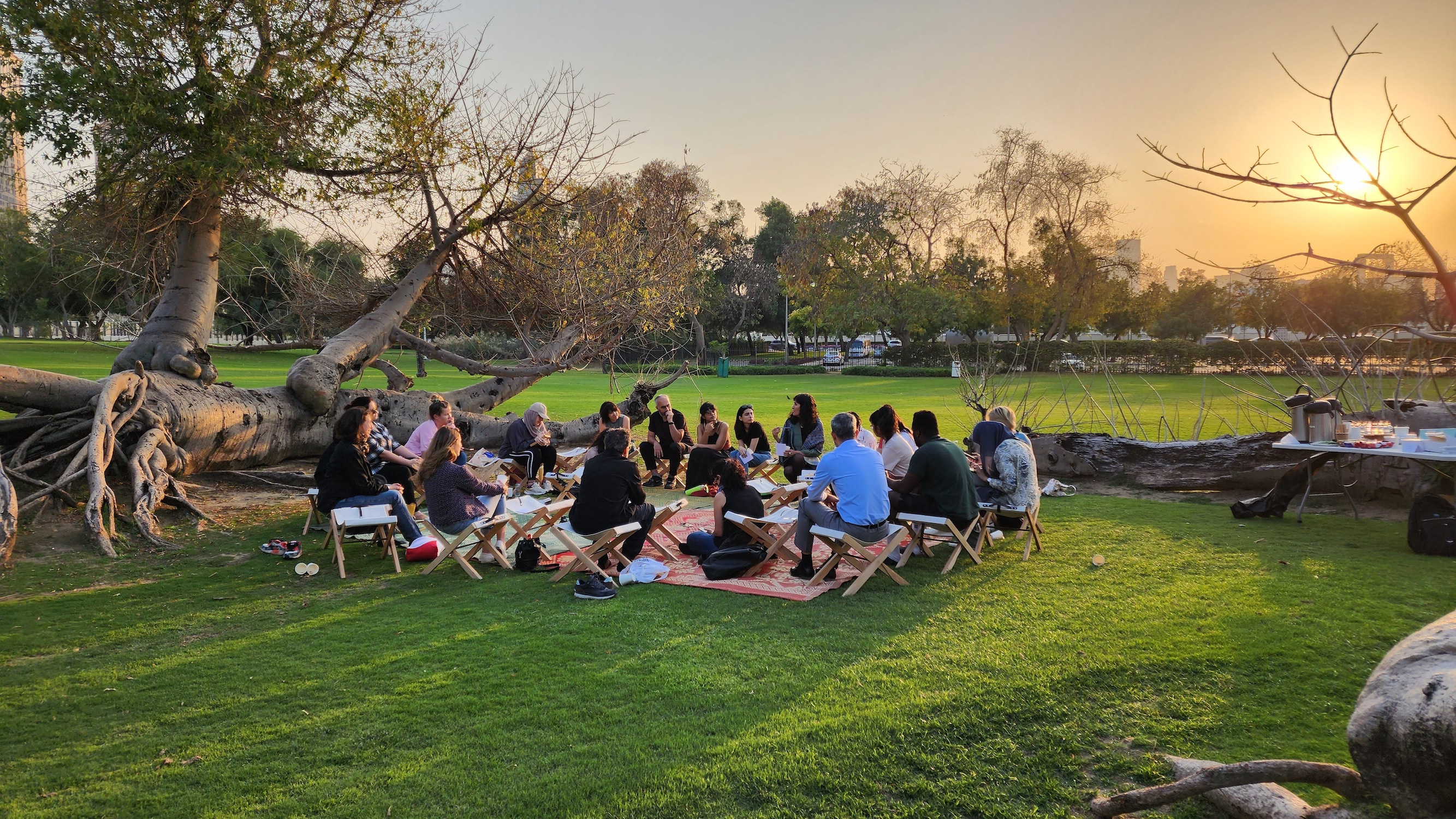
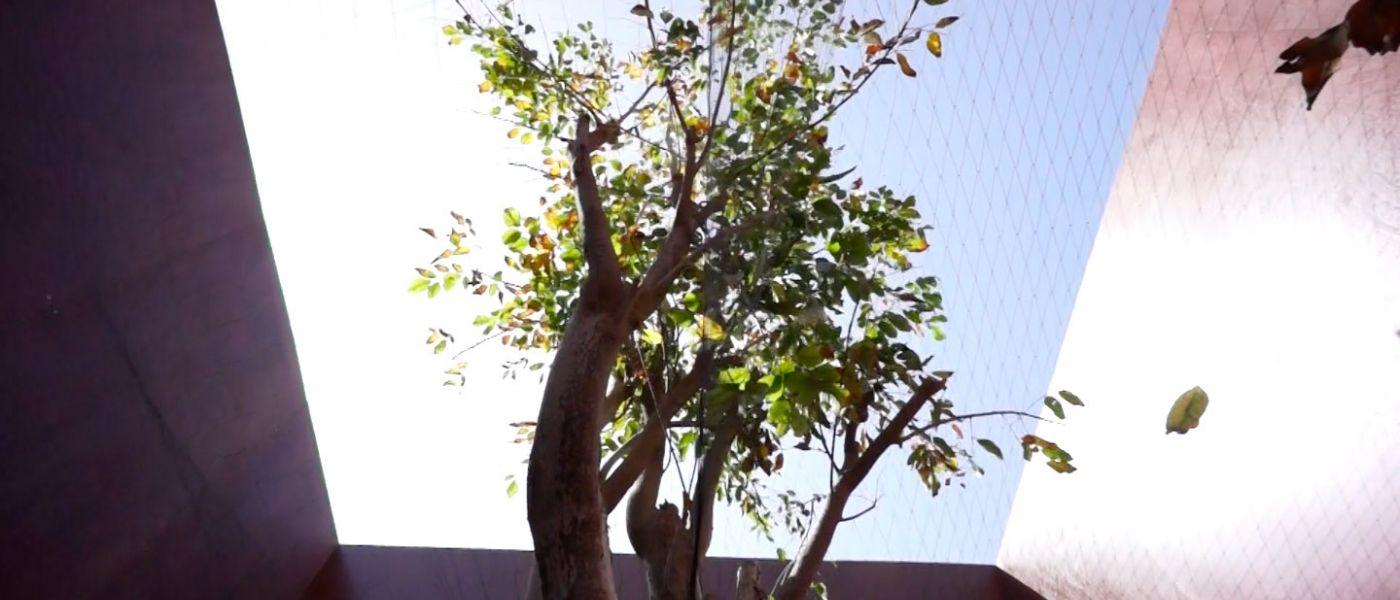
This occasion marked the beginning of Tree School and DAAR’s continuing commitment to notions of non-hierarchy and unlearning in knowledge creation. Nine years later, in the midst of a sprawling Baobab tree in an indiscriminate corner of Creek Park, Dubai, Sandi and Alessandro hosted the latest edition of Tree School.
Tree School is a project about pedagogy, yet it begins with the prompt: ‘What is Home to you?’ At first, the question seems like an icebreaker rather than an investigation into the project itself, but as spaces of confluence, ‘home’ and ‘school’ are indeed interlinked.
The question ‘where are you from?’ or ‘where do you call home?’ is loaded. When Sandi and Alessandro asked the question last night, they invited us to articulate a feeling of home and share our struggles around home, presupposing the physical and emotional conflicts it invokes.
An Iraqi participant described the feeling of putting up a painting on the wall for the first time after becoming a naturalised citizen of another country, and taking it for granted years down the line. Another described the feeling of neither ‘here nor there’. Another raised the irony of feeling at home under difficult and precarious circumstances, but discomfort under idyllic ones. One participant described herself as ‘simply nomad’. Many participants echoed that after searching, they found home within themselves particularly within their body as a vessel that moves through the world. It is resonant of the resolve of the Quilombos, embracing the concept of return in the planting of a tree.
As one participant noted, we inhabit a time where displacement is more normal than not. But I was not expecting this readiness to accept home as physically unbound and elusive. Is it an unfulfilled acquiescence, or true liberation? I worried that this resolve is complacent in the face of our hard-fought anti-colonial struggles. That is until a participant reminded me of my own experience of finding a sense of belonging among communities that share struggle with one another irrespective of geography or language. And I began to ask myself how the struggle for the land is different than the struggle for home. What are the boundaries of home-land?
I looked above at birds circling above us and the baobab tree and thought, perhaps we are now more like migratory birds than like trees; for us home is someplace to return to.
Day 2 | Alserkal Arts Foundation Project Space
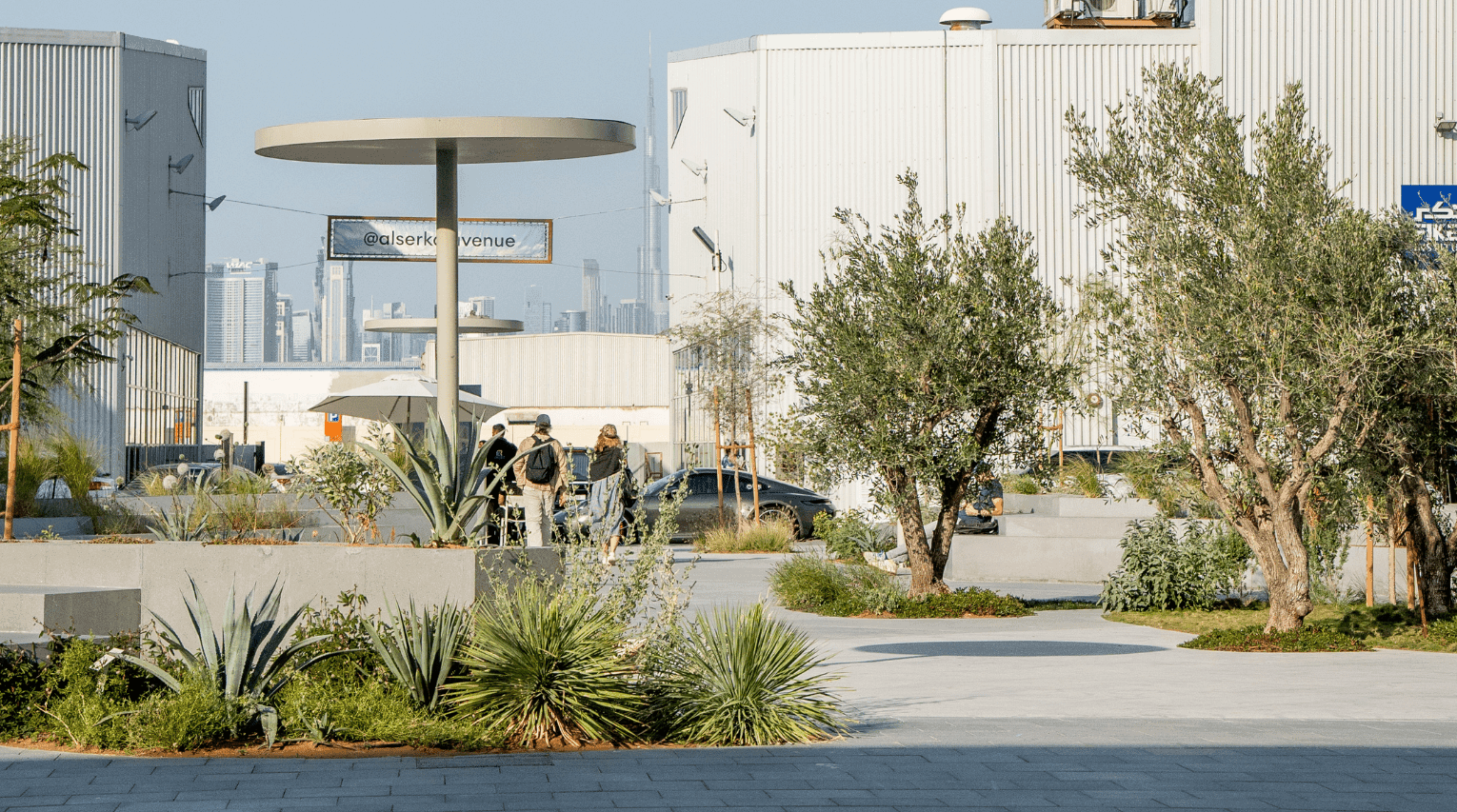
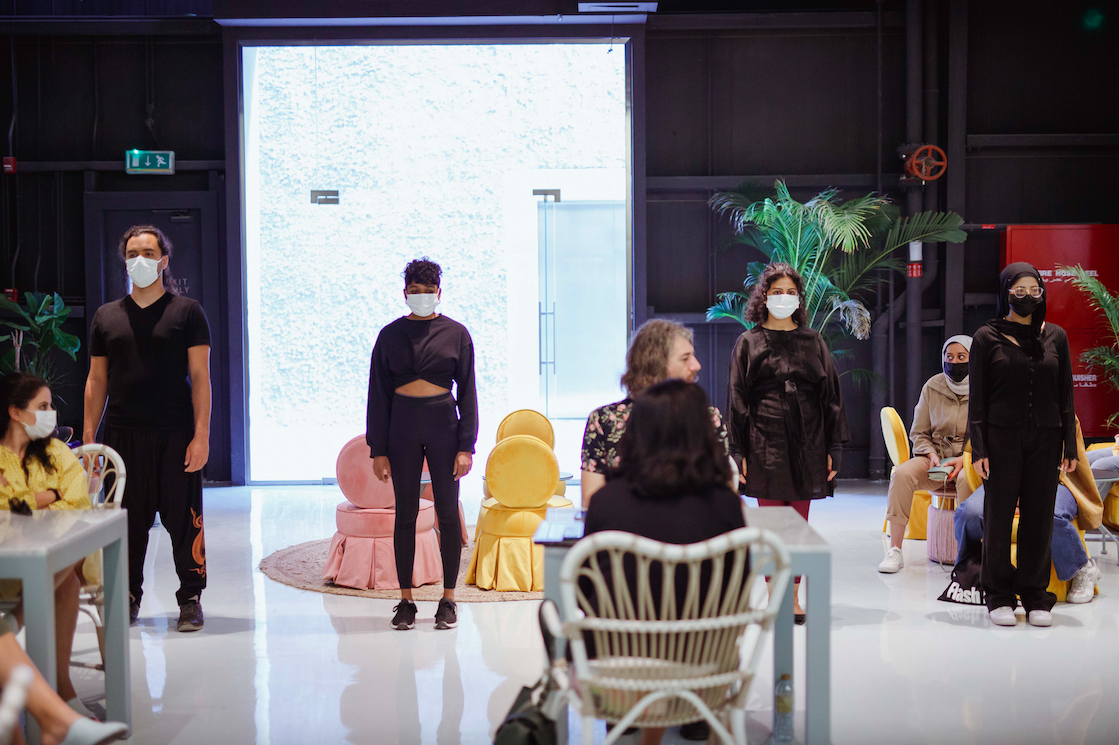
The second session of Tree school was hosted in a majlis setting at Alserkal Avenue, a slight departure from the shade of a literal tree. The majlis represents the traditional setting of hosting in the Gulf, and our gathering there was intended to complicate traditional hosting spaces through notions of non-hierarchy. While the environment affects the shape that the gathering takes, nothing– or rather no-one is more determinant of Tree School conversations and learnings than the participants themselves. We are the sources of knowledge in the room and our contributions form collective threads of thought, and in many instances, tangle and untangle them.
We speak together in the English language, but our linguistic, cultural, and political histories are significant. Certain words from languages that Sandi and Alessandro inhabit have endured with them across multiple tree schools, including the Italian word Ritrovo meaning joy in togetherness, and the Arabic word Mujawara for an indigenous neighbouring practice connoting non-hierarchy.
While DAAR has resisted institutionalising a methodology for Tree School, they lean on keywords as ‘ingredients’ to constitute a sort of glossary. They stress that they are only offering ingredients— and not the recipe— leaving each participant to taste and cook as they like. They invite us to propose words to the list in an effort to expand or reinforce our collective knowledge frames.
One word proposed by Sandi following the thread surrounding home, is the word Ghurba. Coming from the root Gharb, or West, (referring to where the sun sets, rather than the geopolitical identifier of the ‘Western world’) the Arabic word Ghurba speaks to the feeling of estrangement. Urdu speaking participants noted how it may have traveled to mean loss or impoverishment. Persians emphasised the inflections of nostalgia in the Farsi term, and a Turkish speaker explained that it is used as a way of identifying the state of living abroad rather than an emotional condition.
It matters where words come from and how they travel. Defining words and unearthing their roots is like asking words the same questions we have so thoughtfully and carefully been asking each other: ‘where do you call home?’. But to some, the return to this question seemed superfluous, the complication of language seemed unnecessary and they argued that human connection should transcend all that.
Yes, the question “where are you from” may not always be friendly or welcome, but as a participant pointed out, it matters who asks it, and why. Unfortunately human connection is not class- nor colour-blind and we all fall within layered global and local power structures that— whether we acknowledge or not— we navigate everyday with varying degrees of privilege.
I noticed that alongside the practice of definition, we were practising another epistemology: that of differentiation, or signifying slight differences between similar words in an effort to understand ourselves and each other better.
To differentiate between two Arabic words for home: Bayt, which comes from the space where one sleeps, and Dar, which originates from drawing a circle surrounding oneself, denotes the active verb in dar that distinguishes it from bayt.
The reason that Sandi and Alessandro define words in multiple languages, differentiate across them, and encourage the introduction of new words to be applied across contexts, is because Tree School is an opportunity to generate collective knowledge that does not depart from imposed frames, but from our lived experiences. Perhaps the reason Tree School asks the personal questions ‘where are you from’ and ‘what is home’ in order to force us to return to the foundations of where subaltern and subconscious knowledge lies.
In response to the effort to develop the Tree School glossary of words, one participant problematized the initiative, saying that power dynamics do not only exist among people but across languages: not only with English as the dominant language with pervasive colonial impact but in the relation between Arabic and South-Asian languages in the Gulf. It is these context-specific questions that Tree School generates and grapples with.
Day 3 | Desert Campfire
When we arrived at the desert for the third session of Tree School, a few of us kicked-off our shoes and socks, dug our feet in the sand, and went to climb up the dunes. When we returned to the meeting point, we found a small campfire, karak tea, and an oud player who had infused the atmosphere with familiar medlies from across the region; conjuring home for many of us.
You could sense that strangers had broken a threshold, and return-participants had formed a repertoire. I may still not know a participant’s name, but I have by now learned that like me they struggled when moving to Dubai or that we both hesitate before public speaking.
By the time we formed a circle there was a warmth that did not simply emanate from the campfire. People riffed off of each others’ stories, told jokes, and laughed freely. Those who had stayed silent in past sessions were sharing with ease. I noticed I was making more eye contact. Something had dissipated. The oud player sat among us, and Sandi— who had in a previous session confessed that her experience of ghurbah made listening to Arabic music at length difficult— willed the oud player to play in frequent intervals.
Not much later, it started to rain. When does it rain just like that here? And in the middle of the desert no less. Someone reminded me of cloud seeding which slightly dampened my enthusiasm, but not my imagination that in some way this rain is the watering of Tree School seeds that seemed to be now setting fruit.
We broke out for grilled corn under the rain and the music lured us back to a makeshift tent which we huddled under, this time closer together.
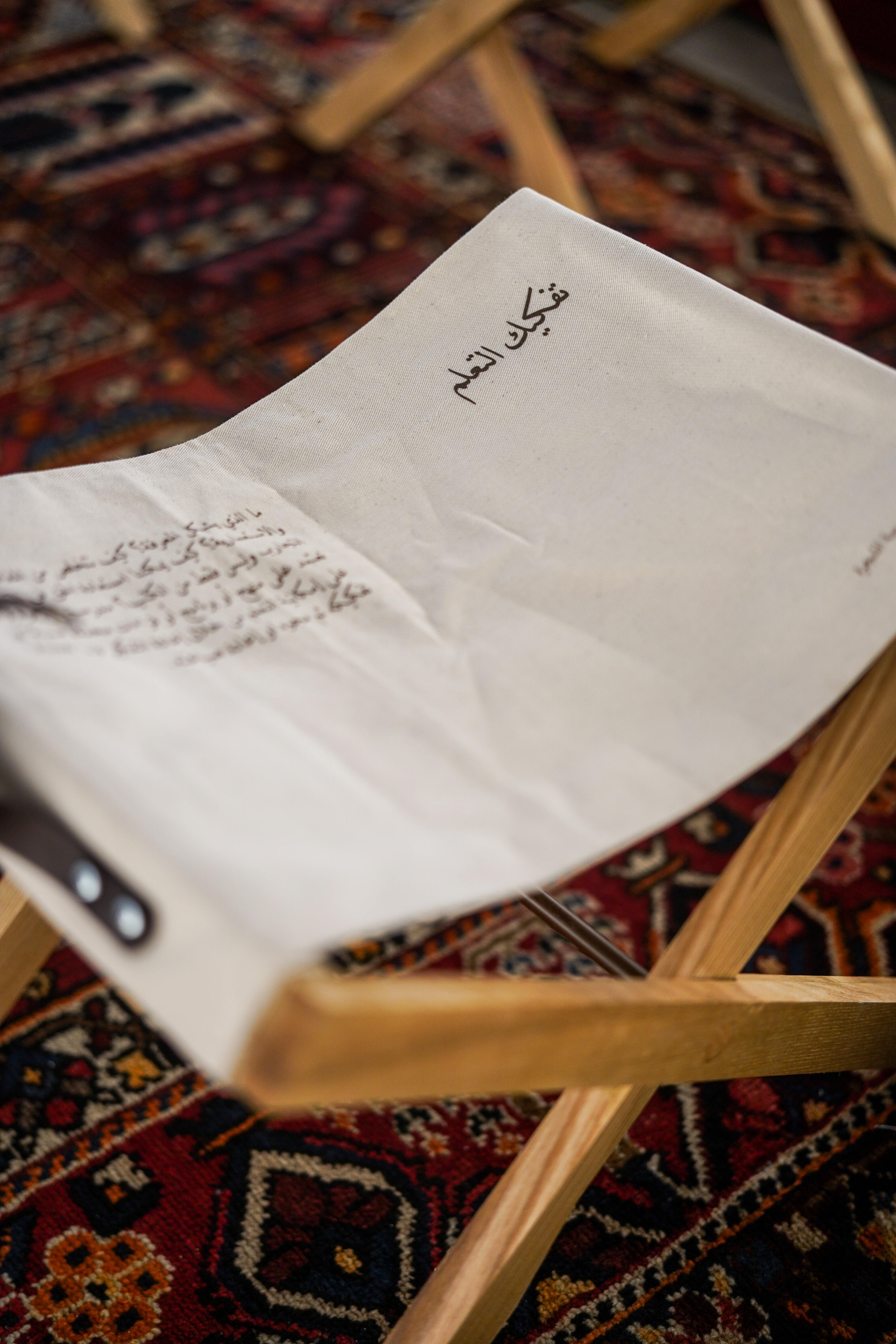
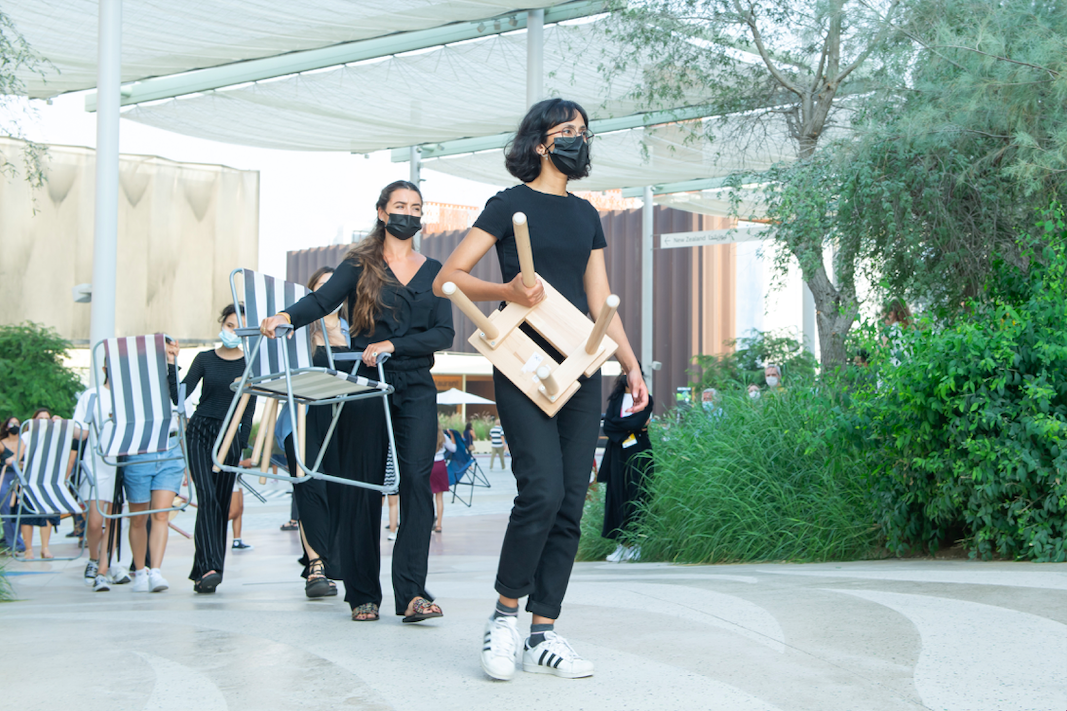
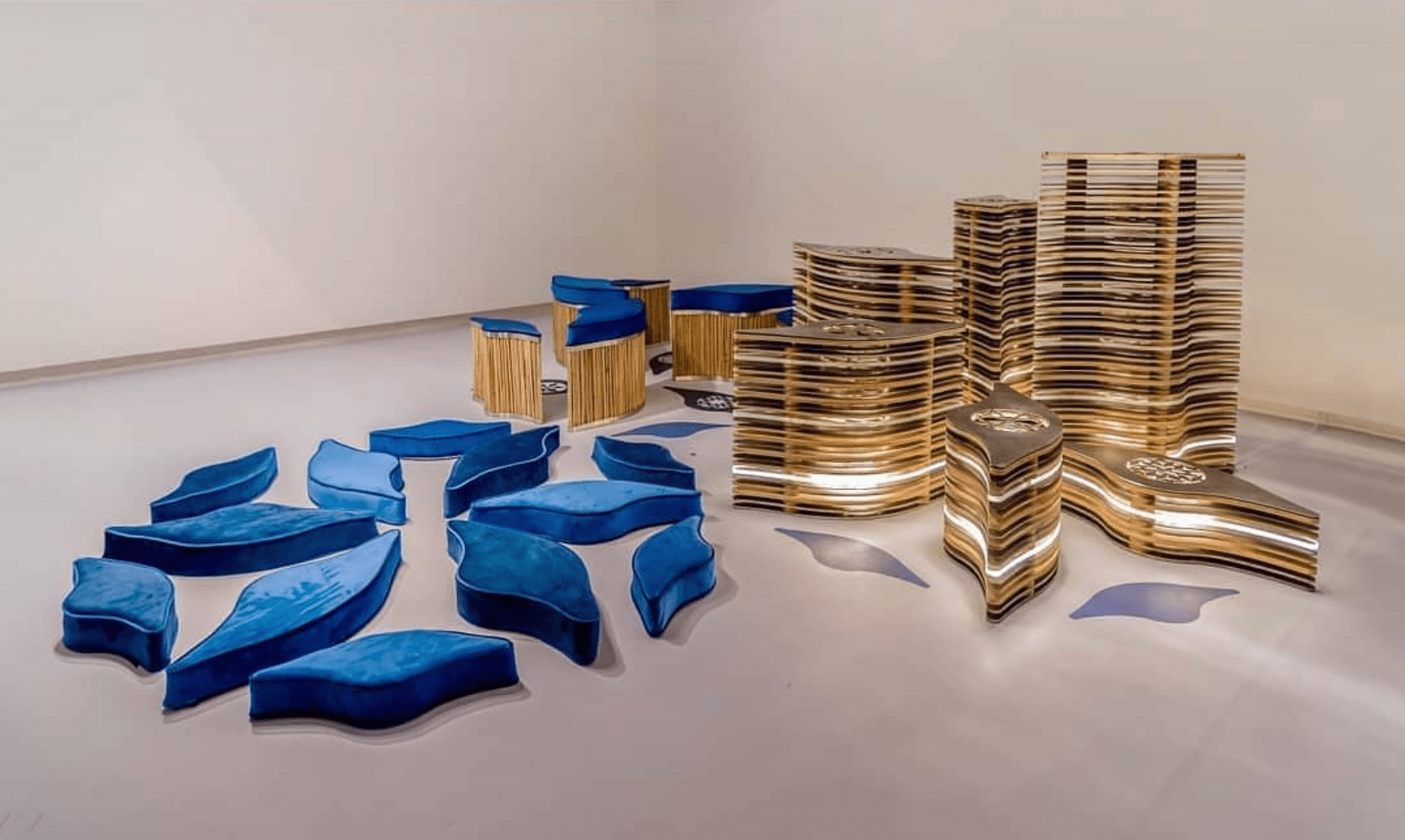
The seats produced by Alserkal Foundation for this Tree School edition were wooden stools with keywords and their definitions printed on the canvas seat. The stools intentionally opened to look like book easels where we would sit as sources of knowledge or open books. So many of the words we had been discussing in the abstract came to life, making themselves felt and understood.
Below are some of the Tree School terms participants chose to share or new ones they introduced with an accompanying reflection during this session:
Transgression or Tajawoz:
Sandi invoked the word transgression again, but it took on a new meaning in this moment. She explained how Tajawoz (transgressing) and Ijaza (vacation) share the root ‘Jaza’ in Arabic, meaning ‘you can’ or ‘you are permitted’ verging on ‘you should’. Going to a place of rest, comfort, fun, and freedom is transgressive and indeed transformative. I witnessed this manifest in the ease with which the conversation flowed when people did not take it so seriously.
Dislocation:
Perhaps we wouldn't have understood the significance of unpredictability and transgression if we did not dislocate, or come to the desert. In the first session, Alessandro had noted the importance of bodies in generating thoughts and feelings about home and other personal inquiries. I had struggled with this in the majlis, but it felt more immediate barefoot on the sand, moving across the circle, disfiguring the circle, and even standing up to be heard when we spoke.
Liver:
A Somali participant proposed the word Liver. She explained that in Somalia the liver is an organ housing love. For her home was visceral. Whether it came with ache, angst, or relief, the feeling lived in the body and not the mind.
Honesty:
Despite degrees of anxiety that we all may feel in public and/or intimate settings, so many participants have been forthcoming. Modern standards of knowledge are meant to be scientific, objective, logical, but it fails the test of time if it is not honest and vulnerable. Last night, rather than talking about the intellectual or generalised condition of ghurbrah, one participant who was shy to speak confounded me with his bravery by saying that he was feeling plain loneliness. Spaces of gathering like Tree School could achieve intellectual interventions but they create spaces of reprieve more urgent and rewarding, even necessary.
Friendship:
At least two participants introduced the word friendship in different languages. ‘Walii’ specifically from the Quran for a friend that provides a protective presence, and ‘khairkhwah dost’ in Urdu for a friend that takes care of you.
Apapachar:
A Mexican participant put forth the Nahuatl word Apachocho meaning ‘hug from the soul’ and even if we didn't break out in a physical group hug, it felt like the word, in all its simplicity, touched each of us.
Although what happened yesterday felt accidental, it may have been the point all along.
Day 4 | Al Shindagha Museum & Mazmi Cafe
The closing session of Tree School began in Perfume House at Al Shindagha Museum and ended in a creek-side cafe overlooking docked and sailing dhows. These locations were meant to invoke a significant component of Tree School; space and how it shapes host and guest relationships.
Throughout the sessions Sandi and Alessandro were central facilitators, and Alserkal Foundation organisers. Now we entered a non-public space that was not set up nor catered by Alserkal Foundation.
The Perfume House is a sensorial exhibit of Emirati rituals and traditions. There, Alessandro invited us to reflect on what we consider knowledge and how we overlook forms of knowledge when the bulk of our heritage, like bakhour, is invisible. So much of it is shaped by cultural practice.
Hospitality is a ritual-based practice across the region. In Emirati culture, incense is lit in anticipation of guests' arrival to welcome them, and turnt off to signal the end of a gathering.
Think too about how people across the region fight— oftentimes tooth and nail— to pay the bill. This practice is dumbfounding to Western onlookers. However, Sandi argues, it is not just an act of courtesy, but a deeply seeded way of holding power.
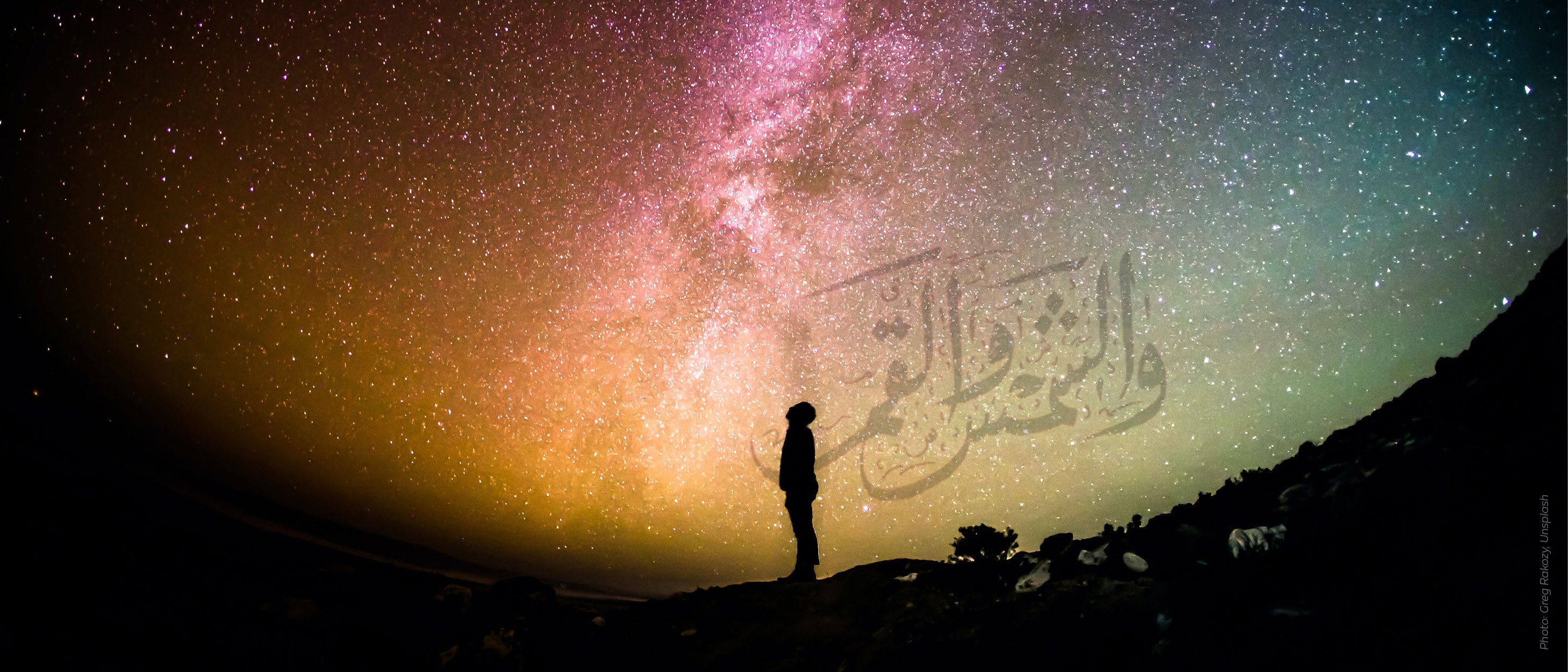
According to Islam – الضيافة ٣ أيام وما بعد صدقة - translating into “Hospitality is for 3 days, and thereafter it is charity”. This is not only to say that guests should not overstay their welcome, but also that if we do not hand over power and let others host, that we inevitably begin to exploit our power.
It was now the fourth day of Tree School, so three days of hospitality had elapsed. At the cafe neither DAAR, nor Alserkal Arts Foundation, nor the participants hosted— but a neutral third party. It was there that we were to say our goodbyes. In Arab culture, goodbyes can take longer than the initial gathering, and Sandi and Alessandro seemed to have accounted for this by dedicating the session to it.
In our last hour together, which Sandi loosely termed ‘closure’, gratitude was the defining sentiment. One participant described how over the past four days she had overcome her fear of public speaking. Another acknowledged the kinship and community they found among others. Another expressed relief at the rarity of a conversational setting formed around doubtful and personal knowledge rather than regurgitating the news and name dropping. One participant gave gifts, handwritten words she noted from conversation, handing one to each participant. DAAR and the Foundation reciprocated thanks for the faith they shared in each other upon collaborating.
Then we asked what next? When will the next Tree School take place? Can we replicate it within our communities? How do we put our newfound learnings to practise? These questions continue to ring in my head as they, in typical Tree School fashion were left unanswered, almost intentionally.
Before leaving, I hugged Sandi goodbye, and she asked me to deliver hugs, kisses and new educational rituals that I’ve learnt (including all I am actively unlearning) to my baby daughter. I smiled. I am particularly grateful to Tree School for introducing me to methods of subverting traditional educational systems.



What We Plant, What We Owe
I grew up in a small village in southern Slovenia, surrounded by forests. My grandmother gathered herbs; my father and grandfather worked in forestry. From our elders, we learned that the forest gives and the forest takes. We also learned to take only what we needed, and to understand that the forest was not ours to possess.
This knowledge has stayed with me. It shapes how I think about our relationship with the living world, and how I approach the history of the Non-Aligned Movement: not only as a political project of decolonisation and independence, but also as an unfinished experiment in imagining how we might live together, across differences, without submitting to the centres of power.
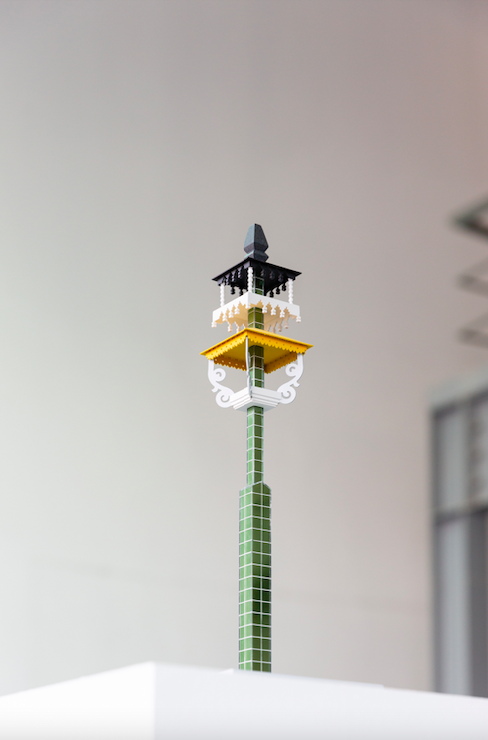
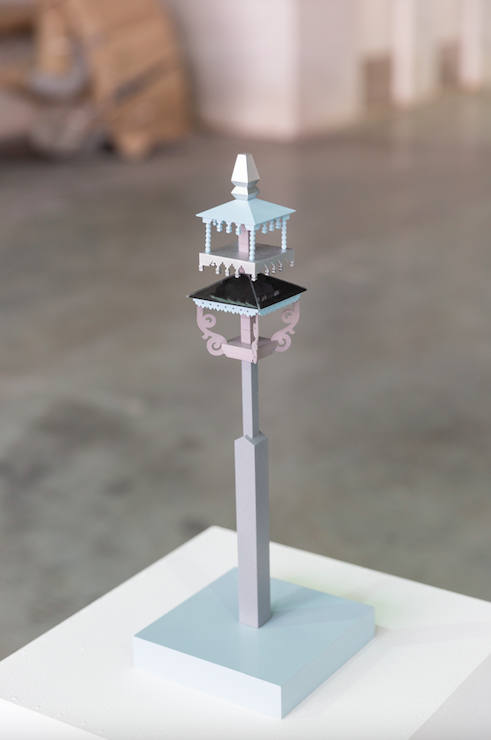
At the founding conference of the Non-Aligned Movement in Belgrade in 1961, political leaders planted plane trees. Similar ceremonies took place at later summits, with trees chosen for their particular meanings and origins. Flowers, too, were carefully arranged for meetings and diplomatic encounters. These gestures might seem ceremonial, even ornamental. Yet a tree is never only a symbol. It takes root in a particular place, draws water from the earth, grows through time, and outlives those who plant it. It reminds us that political futures, like forests, require conditions in which different forms of life can exist together. But still, we must ask. Who plants, and on whose land? Who decides what should grow, what must be cleared, and which forms of life are considered expendable? The planting of trees, like the language of conservation itself, can also carry the legacy of colonial control over land and people. Colonial forestry turned forests into sources of timber and revenue, closing them to those who had lived from them for generations. Many protected areas were created by displacing the very communities who had cared for the land.
Environmental concerns were not at the centre of the Non-Aligned Movement’s early programme. Gradually, however, ecological balance became inseparable from issues of sovereignty, development and global inequality. The point was larger than protecting nature: it was to ask who profited from its destruction, who controlled its resources, and who was expected to pay the price. These questions remain urgent.
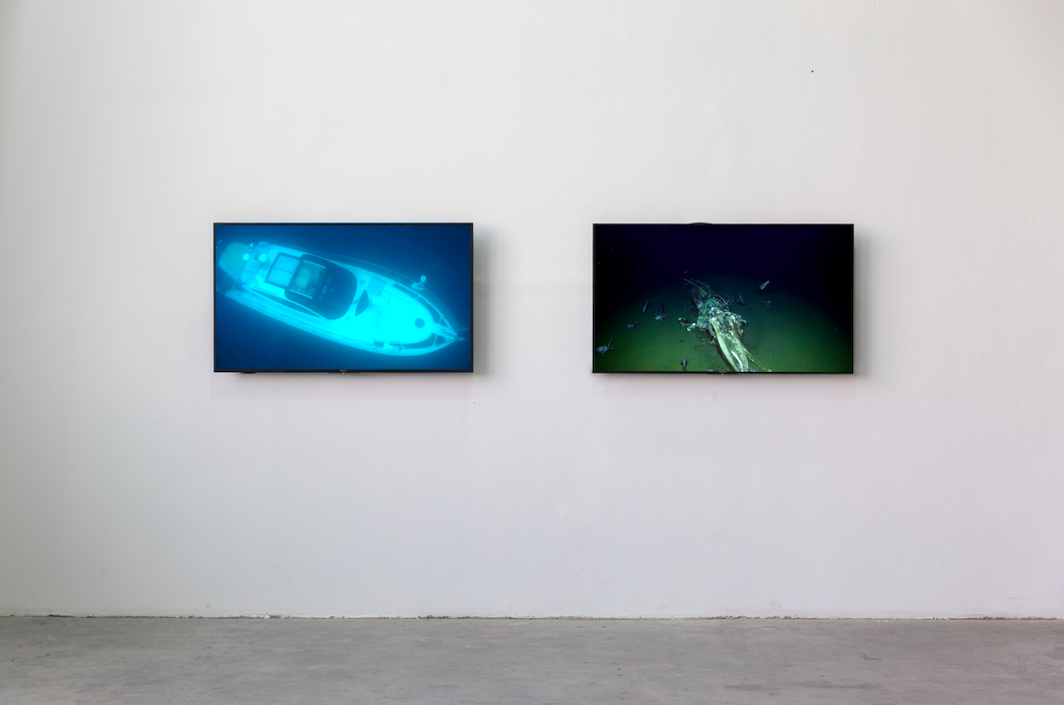
From oil extraction and poisoned landscapes to deforestation and the destruction of ecosystems through war, environmental devastation follows the unequal distribution of power. In Gaza today, the destruction of land, water, farms and olive groves, what many describe as ecocide, shows how the erasure of a people and the erasure of their living environment go hand in hand. To uproot an olive grove is to undo the act of planting, and with it a people’s claim to a future on their own land. There is only one Earth, but we do not inhabit it on equal terms.
Perhaps flowers and trees offer a way of thinking about solidarity beyond political declarations. Not as a universal language that erases differences, but as a practice grounded in specific places, histories and responsibilities. A seed carries the possibility of a future, but never guarantees it. What grows depends on the soil, the climate, the hands that tend it, and the forces that threaten its survival.
To return to the Non-Aligned Movement today is not to restore an idealised past. It is to ask what remains of its unfinished promises, and what new forms of solidarity they might make possible. What would it mean to treat the Earth not as property or an inexhaustible resource, but as a shared condition of life?
We are guests here.
Bojana Piškur
Ljubljana, Slovenia
About the Non-Aligned Constellations Working Group
Grounded in the concept of ‘constellations’ and derived from the Southern Constellations exhibition series (launched in 2019 at Moderna galerija, Ljubljana, Slovenia), this research explores the intersection of art, history, and geography, with a particular focus on the global relationships fostered through the Non-Aligned Movement (NAM). The project investigates the legacy of the Gallery of Art of the Non-Aligned Countries Josip Broz Tito (Titograd, 1981–1995), whose collection, comprising 800 works from 56 NAM countries, is now housed at the Museum of Contemporary Art of Montenegro. Curators Angelina Radaković, Bojana Piškur, and Natalija Vujošević (the initiator of the Art Collection of Non-Aligned Countries Laboratory project at MSUCG) aim to revive the collection through participatory, experimental, and interdisciplinary methods. By engaging with its historical and political context, they seek to reestablish connections with cultural actors from the Global South. Tracing the exchanges of solidarity, this project will reframe the artworks, offering new perspectives on the cultural and political dialogues that shaped both the past and present.
Bojana Piškur is a senior curator at Moderna galerija in Ljubljana. Her research and curatorial work focus on the Yugoslav and post-Yugoslav context, the Non-Aligned Movement, and the evolving concept of the ‘East(s)’. Since 2019, Piškur has curated and co-curated Southern Constellations exhibitions at institutions such as Moderna galerija (Ljubljana), Asia Culture Center, Gwangju (South Korea), Filodrammatica Gallery (Rijeka, Croatia), Museumof Contemporary Art of Montenegro (Podgorica), the Qattan Foundation (Ramallah, Palestine), National Opera and Ballet (Skopje, North Macedonia), and The Mosaic Rooms (London, UK).
Bodies expanding, bodies contracting
I will tell you exactly where the Gallery of Art of the Non-Aligned Countries is located in my memory, in my body, and in the body of the building itself.
It was sometime around 1986, and I was a ten-year-old girl. As part of a school activity, we visited the Gallery of Art of the Non-Aligned Countries “Josip Broz Tito.” The Gallery was housed in the Petrović Palace, in Kruševac Park. We are in the attic, and it is crowded. The air is stuffy, my sweater is itching, I can feel myself sweating, and my feet hurt because of my flat arches. We are having a music lesson, looking at a collection of musical instruments from Indonesia, Burma, and Congo. Our teacher tells us that we belong to the Non-Aligned Movement. She explains that these instruments were gifts to the Gallery from friendly countries. She tells us that, together with these countries, we form a community committed to peaceful coexistence, one that refuses to join military alliances seeking to dominate others through the law of the strongest. She speaks about anti-colonial and anti-imperialist politics, and about how the community of non-aligned countries holds a different vision of the world, one in which relationships are built on mutual support, respect for others, and recognition of differences.
I do not know how much of the political language our teacher used to explain non-alignment I understood at the time. But I clearly remember the feeling that came with realizing that we belonged to something much larger than the country we lived in. My itchy, sweaty body expands from within, and I am filled with a joyful sense of belonging, pride, and responsibility.
Today, this memory feels like an abandoned utopia. But that utopia had its own public infrastructure. The building has shrunk and fallen into neglect. Since the 1990s, three different institutions have occupied it. Behind it, a new and much larger building housing the American Embassy has appeared. For decades, the collection has remained largely out of public view, while the struggle to bring it back into public life continues, with uncertain outcomes.
For years, researchers supported by grants from European, Canadian, and American universities have been visiting the museum to study and write about the non-aligned collection. Their interest often makes an important contribution to the collection’s visibility and understanding. Yet the question remains of how the resources, authority, and outcomes of such research are distributed. Who gets the opportunity to produce knowledge, build an academic career, and determine interpretive frameworks, and who remains the custodian of archival materials and a provider of information? Do the methodologies and principles underpinning these research relationships reflect the very values that are the subject of the research itself? Are these relationships anti-colonial, reciprocal, and grounded in solidarity?
Young people from the local community who visit the museum know almost nothing about this heritage, or about the Non-Aligned Movement. Their political education takes place within the horizon of Euro-Atlantic integration and the market economy, while historical experiences of alternative forms of international relations have almost disappeared from public education. At the same time, cultural heritage is increasingly valued in terms of its tourism and market potential.
In the post-Cold War order, marked by new forms of neocolonial domination, the heritage of non-alignment is becoming increasingly visible within international academia, while remaining difficult to access for the communities from which it emerged. It acquires new value as an object of research, but not necessarily as public knowledge or social practice. Today, narratives surrounding the political imagination of non-alignment circulate predominantly through the channels of Western academia and within the specialized discourse of contemporary art, in publications and at panels where access is restricted by class, economic, and institutional barriers.
These barriers determine whose bodies can expand from within today, and whose contract. They are not merely obstacles to accessing information, but part of a broader asymmetrical distribution of resources, knowledge, and the possibility of imagining the world differently. In postsocialist societies, where decades of privatization have transformed material and collectively held goods, the question arises whether a similar fate threatens heritage, ideas, and political imagination itself.
I wonder how we can learn from the Non-Aligned Movement today without turning its heritage into yet another resource for academic and market valorization. How can we re-establish the principles of solidarity, reciprocity, and collective action as practices, beginning with research exchanges and the production of knowledge themselves? How can we once again create places where bodies can expand from within, where knowledge can generate a sense of belonging, solidarity, and the possibility of imagining the world differently?
And who will have access to those places?
Natalija Vujošević,
Podgorica, Montenegro
About the Non-Aligned Constellations Working Group
Grounded in the concept of ‘constellations’ and derived from the Southern Constellations exhibition series (launched in 2019 at Moderna galerija, Ljubljana, Slovenia), this research explores the intersection of art, history, and geography, with a particular focus on the global relationships fostered through the Non-Aligned Movement (NAM). The project investigates the legacy of the Gallery of Art of the Non-Aligned Countries Josip Broz Tito (Titograd, 1981–1995), whose collection, comprising 800 works from 56 NAM countries, is now housed at the Museum of Contemporary Art of Montenegro. Curators Angelina Radaković, Bojana Piškur, and Natalija Vujošević (the initiator of the Art Collection of Non-Aligned Countries Laboratory project at MSUCG) aim to revive the collection through participatory, experimental, and interdisciplinary methods. By engaging with its historical and political context, they seek to reestablish connections with cultural actors from the Global South. Tracing the exchanges of solidarity, this project will reframe the artworks, offering new perspectives on the cultural and political dialogues that shaped both the past and present.
Natalija Vujošević is a curator, researcher and cultural organiser based in Montenegro. Her work is particularly concerned with Yugoslav and post-Yugoslav cultural and political histories and with the relationships between historical material, institutional memory, and contemporary conditions. In 2024, she received the Igor Zabel Grant, awarded in recognition of outstanding achievements by curators, art historians, theorists, writers, and critics working in the field of visual.














Stay tuned...


Stay tuned...

Stay tuned...








Stay tuned...