

Allusive Veil
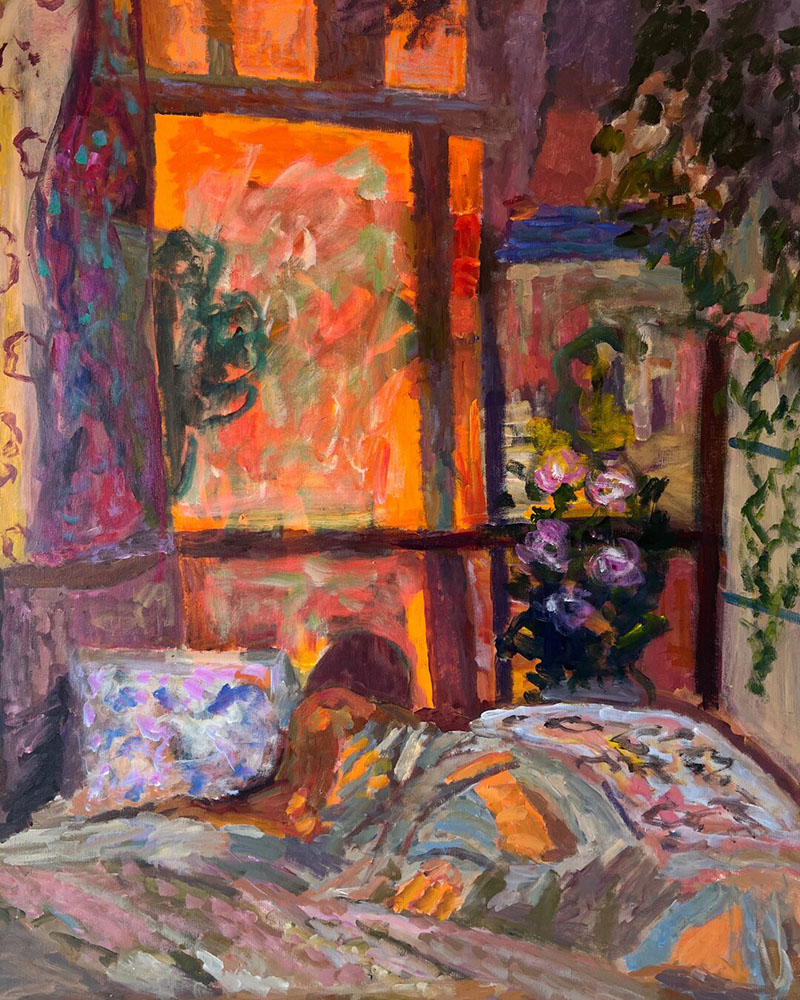
Influenced by 19th-century French painting and beyond, Sharif’s language is foreign to the region and to his local con- temporaries, yet beneath its apparent estrangement, his practice illuminates a rather conservative society, unveiling the subtleties, rituals, and quiet rhythms that shape their everyday life.
Privacy and intimacy are where Sharif introduces color, expressive hues that meld harsh truths with illusions of what could be. Sharif’s approach ensures that his depic-tion of these taboos is conveyed through humble depictions that preserve a certain Oriental sensibility, avoiding the shock value or censorship they might otherwise provoke. The scenes are all about ambiance, a haze of what was, what is, and what could be. While relatable and nuanced, these are very much autobiographical and personal to the artist,about the struggles of private and artist life in a closed society. In keeping with his practice, the scenes remain veiled yet allusive. They tell stories of coming of age, love, and relation-ships that shape our personalities and characters. Hisham’s compositions are built on tension and rich brushstrokes—the same tension the artist lives through, between eroticism and tradition, reflection and reality, memory and imagi-nation, erasure and revelation, and symbolism and bluntness. The targeted areas of color become the subject of the artwork, rather than the reverse, making the human presence within the work the subject only when the artist intends it to—a testament to his compositional strength through color and expressive brushwork. Sharif breaks the fourth wall through his voyeuristic scenes. Each painting, whether small or large in scale, acts as a window into Hisham Sharif’s introspective reflections on his surroundings, which he both criticizes and illuminates. LINK